
Guiyan Jinbaihe Chinese Cigarettes: Like English Dunhill, But Different
Chinese cigarettes can surprise American and European smokers in more ways than one. It is not just the huge variety or the bold pack designs. Many Chinese brands also carry layers of cultural symbolism, and for smokers in China, that symbolism can add meaning that outsiders might otherwise miss.
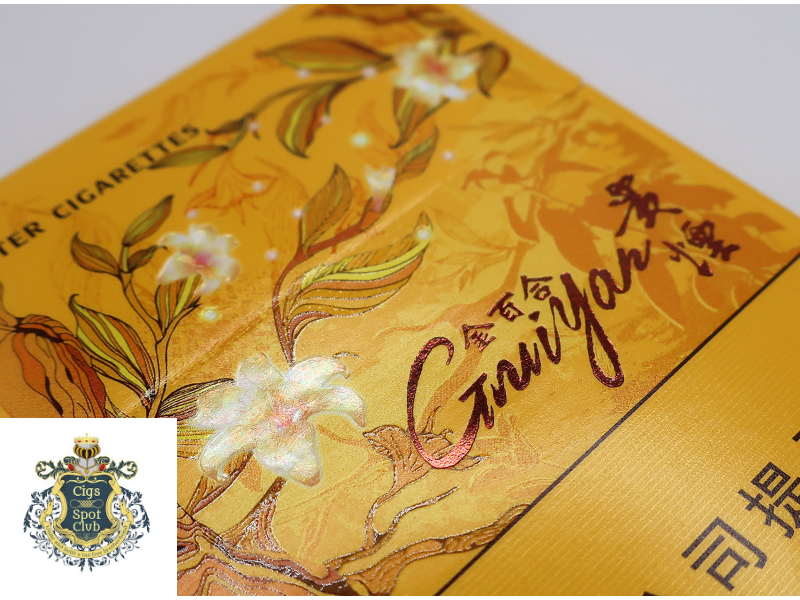
At first glance, a pack of Guiyan Jinbaihe stands out for its unusual design and strong overall presentation. But behind the visuals is a more complete message, where the variety name, the imagery, and even the flavor profile all connect in a way that makes sense within its home market.
Across China, symbols from history, folklore, and regional culture often appear on cigarette packaging. To someone unfamiliar with those references, they may seem decorative or mysterious. To local smokers, though, they can be as readable as a label, giving the product a distinct identity before the pack is even opened.
What Guiyan Jinbaihe Means
In China, these cigarettes are labeled as 贵烟金百合, transliterated in English as Guiyan Jin Baihe. Guiyan is the brand name and refers to Guizhou Province, where the manufacturer is based. The brand has been around since 1979 and remains one of the better-known names in its regional segment.
Jin Baihe translates as Golden Lily. The name is more than just decorative. It is also associated with osmanthus, a flower that plays an important role in the identity of Guizhou and helps explain both the branding and the flavor concept behind this variety.

The connection is fairly straightforward. Osmanthus is a recognized symbol of Guizhou Province, and extract from its blossoms is used as part of the sauce or casing applied to the tobacco. Osmanthus has a naturally sweet, fruity aroma that can suggest notes of peach and apricot, although here it appears in a much more restrained form than many American smokers might expect from a flavored cigarette.
That subtle approach says a lot about the way Chinese blenders handle aromatic ingredients. Instead of pushing the flavor to the front, they use it as a supporting accent, letting the tobacco remain the main event.
Market Position and Price
Jin Baihe is a relatively modern variety, most likely introduced in the late 1990s or early 2000s. In China, it sits in the mid-priced segment, with a domestic retail price of around 10 yuan per pack, or roughly $1.40 at current exchange rates. Even at that price point, it has earned a strong reputation for quality and value alongside established names like Hongtashan and Huanghelou.
Packaging and Build Quality
Because of its distinctive floral design, Jin Baihe is not easy to confuse with anything else. As far as this line goes, it appears to be produced only in King Size, so there is not much variation within the range. The cigarette tubes continue the floral theme from the pack in a way that feels cohesive rather than overdone.
Build quality is especially impressive for the price. The cigarettes are firmly packed, the acetate filter has moderate resilience, and there is no perforation in the filter paper. From the pack aroma, there is no obvious peach or apricot note; instead, the scent comes across as lightly sweet, faintly grassy, and clearly tobacco-forward.
Blend and Composition
The real story here is not the osmanthus extract but the tobacco itself. The blend is built around Qiannan tobacco grown at higher elevations in Guizhou Province. According to the manufacturer, the recipe may also include leaf from multiple harvest years, which would help explain the mature, layered character of the smoke.
Visually, the cut appears to be made up mostly of dark yellow leaf fragments, with smaller amounts of lighter yellow and near-brown pieces mixed in. Expanded stem and reconstituted sheet are present as well, but only in modest amounts, which is normal for a factory-made cigarette in this class.
Important: The pack lists 10 mg tar and 0.9 mg nicotine, which puts this variety in a very approachable everyday range for smokers who prefer a traditional full-flavor profile without excessive strength.
How It Smokes
There is no loud fruit flavor here, and the smoke is far from one-dimensional. The first impression is rich, rounded, and satisfying. In profile, it feels somewhat reminiscent of classic international-style cigarettes from the 1990s, with a flavor that brings to mind well-aged golden Virginia tobacco.
What makes Jin Baihe stand apart is the delicate fruity undertone running quietly in the background. It is only mildly sweet and never overwhelms the tobacco base. That nuance would not usually be present in an old-school English-style cigarette, but here it works extremely well, adding character without turning the blend into something artificial or candy-like.
The strength of the smoke lines up well with the stated numbers. It delivers solid nicotine satisfaction while still feeling refined enough to smoke for flavor, not just effect. For a cigarette in this price class, that balance is one of its biggest selling points.
Why Smokers Notice It
For smokers who already appreciate classic Chinese brands like Huanghelou or Hongtashan, Jin Baihe makes a strong case as another pack worth trying. It combines traditional tobacco character with a subtle regional signature, and it does so at a price that keeps it accessible in its home market.
- Distinctive floral pack design with strong shelf presence
- Good construction and tobacco presentation for a mid-priced cigarette
- Mostly tobacco-forward flavor with a restrained fruity accent
- Balanced strength suitable for regular smoking
- A useful introduction to how regional identity shapes Chinese cigarette blends
Bottom Line
Guiyan Jinbaihe is an excellent example of a mid-tier Chinese cigarette done right. It offers real tobacco flavor, satisfying strength, and just enough osmanthus-driven sweetness to make the blend memorable without pushing it into overtly flavored territory. If you enjoy classic tobacco character with a subtle twist, this is one of those packs that feels worth keeping around as a reminder of how nuanced a factory cigarette can still be.
Product packaging, blend details, and market pricing may vary by production batch and region.