
Arnold Schwarzenegger Returns to the Terminator
Adapted from a 2019 magazine feature and rewritten for a U.S. audience.
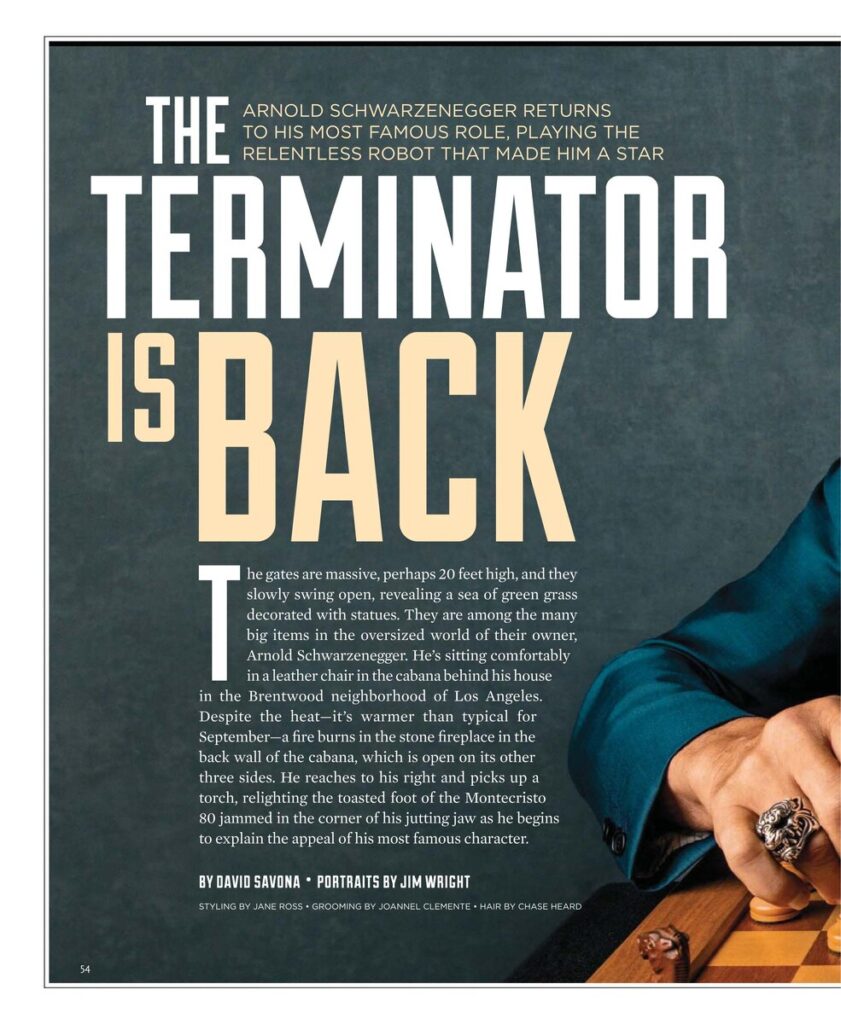
The gates are enormous—some 20 feet high—and they slowly swing open to reveal a green sea of lawn dotted with statuary. It is only one piece of the impressive collection of “toys” in the sprawling world of their owner, Arnold Schwarzenegger. He is settled comfortably into a leather chair behind his home in Los Angeles’ Brentwood neighborhood.
Despite the heat—it is warmer than a typical September day—a fire burns in the stone fireplace on the far wall of the cabana, which is open on the other three sides. He reaches to his right, picks up a torch lighter and relights a Montecristo 80 clenched in the corner of his prominent jaw before explaining the secret of the appeal of his most famous character.
By David Savona • Photographs by Jim Wright
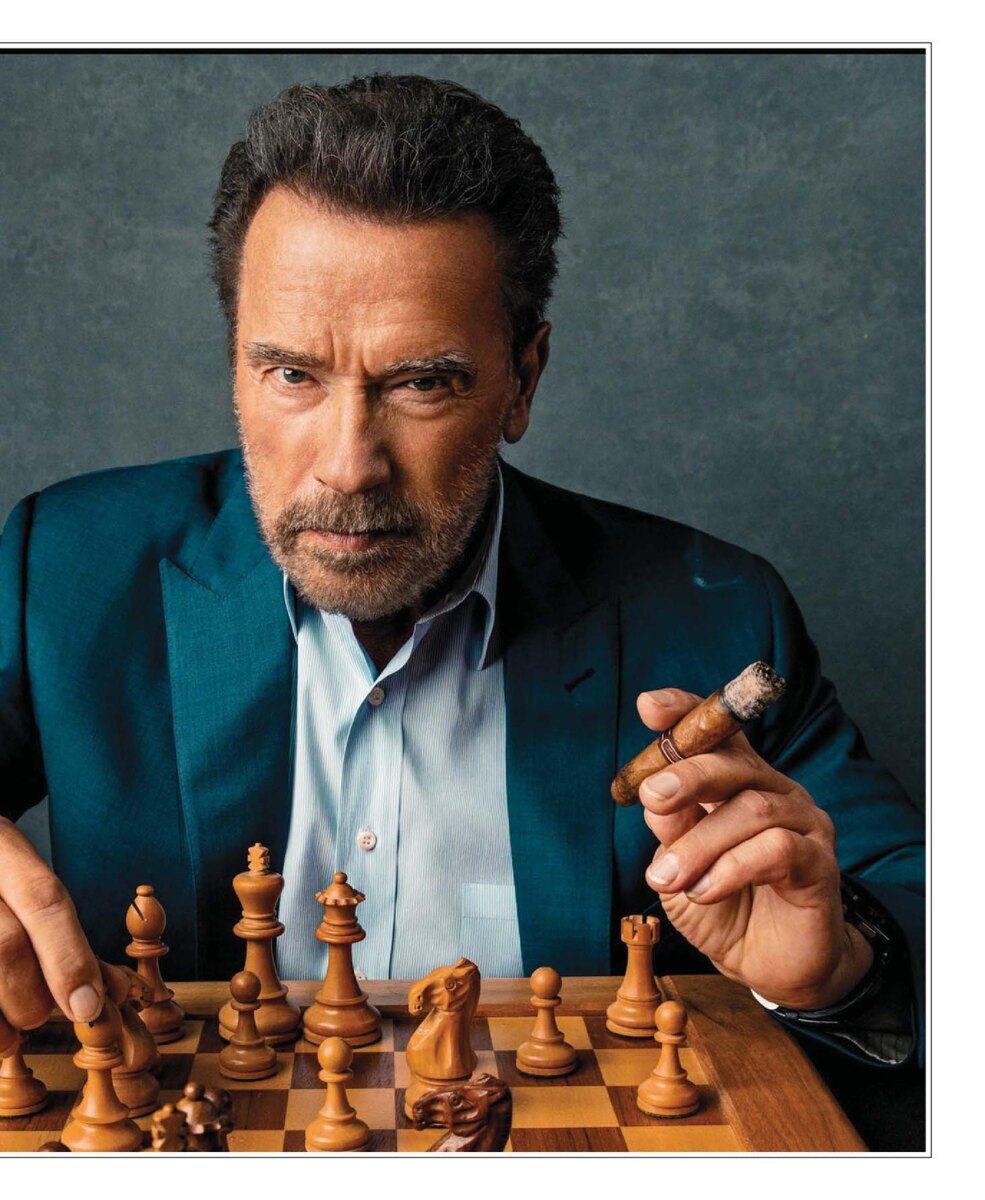
“The biggest step in my career was The Terminator,” he says between puffs of his cigar. On Nov. 1, he returned to the big screen as the machine built for killing—the very role that made him one of Hollywood’s biggest stars. Terminator: Dark Fate marked the sixth film in the franchise, reuniting Schwarzenegger with Linda Hamilton and James Cameron, the filmmaker who created the character and directed the first two films.
But what keeps audiences coming back? What is so compelling about a cold-blooded machine sent back through time from a future in which computers have conquered the world? “People like to identify with that character. They are so angry about what is happening in their lives and in the world,” Schwarzenegger says. “They want to fight back, but they don’t have the power.”
Schwarzenegger recalls a scene from the first Terminator, released in 1984, to illustrate what power means. The robot has tracked down his target, Sarah Connor, and comes to the police station. The Terminator asks the desk officer where she is. “The guy says, ‘She’s making a statement. Why don’t you have a seat over there?’ He doesn’t even look up; he keeps writing. Then the Terminator just looks around,” Schwarzenegger says, acting out the scene. “He thinks, ‘That can be fixed.’ He calculates the option. Then he says, ‘I’ll be back.’”
In the film, only seconds pass before the calm of the police station explodes into chaos: the Terminator crashes a car straight through the wall, killing the officer who brushed him off. Schwarzenegger laughs as he retells it, cigar in hand. The point, he says, is simple: the Terminator does not wait in line.
One of Schwarzenegger’s assistants emerges from the house carrying a small plate of cookies and offers one to the boss to go with his espresso. Schwarzenegger jokes with him, then takes a bite. “He wants us to gain his body-fat percentage,” Arnold says, patting a stomach that still looks impressively flat. “It gets harder and harder every time.”
Schwarzenegger was in his early 70s at the time of the interview, but he looked noticeably younger despite the gray in his beard. He is wearing shorts and a dark green T-shirt, the muscles in his legs still rolling under the skin, and his famous biceps—no longer as enormous as they were during his bodybuilding prime—still dwarf the arms of most ordinary men.
He still works out every day. This morning began as usual: he woke up to the news on the television in his bedroom, flipped through the Los Angeles Times to keep up with the day’s major stories, then rode his bike to Gold’s Gym in Venice to pump iron and flood the world’s most famous muscles with blood. He earned the cookie.
He earned the cigar too. He has been smoking them nearly all his life—the first one before he was 20. At 31 he had his first proper premium cigar, a Montecristo No. 2, and soon he was enjoying all kinds, with a particular affection for classic, old-world profiles. He turns poetic when describing the farm-like aroma you get when opening a box of fine cigars. “I always smell it,” he says. “A real cigar has a distinct earthy aroma.”
He smiles, then takes a deep sniff through his nose: “Ahhh.” The Monte he is smoking now is fairly large—6.5 inches long with a 55 ring gauge—but that is unusual for him these days. “I used to like bigger cigars, but now I prefer smaller ones.” He names the Partagás Serie D No. 4 as his favorite size.
His humidors are packed with cigars—he says he owns more than 100 different humidor models—and on one of the kitchen tables lies a pile of cigars from Honduras, Nicaragua and other origins, including Liga Privadas and CAO Flatheads. Some are in boxes, others are singles.
Schwarzenegger’s house is full of cigars, but he does not collect them just to admire them—he smokes them. One cigar a day, every day. And he shares them freely with friends. When people give Arnold gifts, that gift is often a cigar. “I’ve been very lucky, I’ve been given many different cigars that I love and keep on hand,” he says.
A 50-year film career and successful real-estate deals have put Arnold in this comfortable position, and the Terminator remains his most famous role. It is also, incidentally, a role he nearly turned down. Although he always wanted to be a leading man, Schwarzenegger was selective.
Long before he started making fortunes in the movies—Terminator 3: Rise of the Machines reportedly earned him $30 million, one of the biggest paychecks in film history—he was profiting from other ventures. “I learned very quickly from experts that people often are forced by financial reasons to take any role,” he says. “As creative as Hollywood is, on the other hand it can be damn stupid. They fall into these traps. What do you do with a muscular guy? Make him the villain. Not the one who saves the day—the villain.”
Those roles did not interest him. “I said to myself, whatever you do in life, you have to be a businessman. In anything, you need to know how to turn one dollar into two.”
Financial Independence Before Hollywood
He took business courses, started a mail-order company selling workout programs and invested in California real estate. He saved $27,000, borrowed another $10,000 and bought his first six-unit apartment building for $240,000. Two years later, he sold it for $390,000. One building led to another, and soon he owned hundreds of apartments.
“I was a millionaire long before I ever got into movies. And the reason I insisted on financial independence is that I didn’t have to take roles for money.”
So when he sat down for lunch with Cameron in the 1980s, he already had Conan the Barbarian on his résumé and wanted to build his hero image. Playing a killer robot did not initially appeal to him. He had originally been considered for the role of Kyle Reese, the man trying to save Connor from the ruthless machine, but over lunch Cameron changed course and offered Schwarzenegger the robot role itself.
Cameron sold him on the idea by explaining that the Terminator was not a traditional villain, just a machine carrying out its mission. Critics praised The Terminator, and the film became both a critical and commercial success. Schwarzenegger says no one expected such strong reviews, and the studio was amazed the film rose above the cheap B-movie label it might easily have worn.
The movie also succeeded financially, grossing $78 million on a $6 million budget. The story continued with Terminator 2: Judgment Day, the top-grossing film of 1991, which earned more than $500 million worldwide. Altogether, the first five Terminator films brought in nearly $2 billion. Schwarzenegger appeared in all but one, as he was serving as governor of California during the production of Terminator Salvation.
Back to the Franchise
The Terminator storyline became tangled after the second film. Cameron, who wrote and directed the first two movies, sold the rights to the franchise and had no involvement in the third, fourth or fifth entries. The character moved from studio to studio, and the time-travel premise made it possible to rewrite the story almost at will.
But Cameron later regained the rights, and Terminator: Dark Fate was positioned as a direct continuation of the story from the first two films. He co-wrote the movie and served as executive producer. The director was Tim Miller, the filmmaker behind Deadpool.
Miller is enthusiastic about Schwarzenegger’s magnetism, which works whether he is playing hero or villain. “Whatever Arnold does, people love him,” Miller says. “If he’s the bad guy, people love him, and if he’s the good guy, people love him.” He calls Schwarzenegger “the embodiment of the action hero.”
The film also reunited Schwarzenegger with Linda Hamilton, reprising her role as Sarah Connor. In the first film, her character was hunted by the Terminator; in the second, protected by him; and in Dark Fate, she appears to have formed an uneasy alliance with him.
The Terminator is described as “a cybernetic organism—living tissue over a metal endoskeleton.” He is incredibly durable, but the flesh around him can bleed and age, and the computer controlling him can learn and change. So while Schwarzenegger plays the same machine model in every film, each version carries its own nuances. “I think in each Terminator I’m playing a slightly different role,” he says. “The missions are different, and how long I’ve been around humans changes my behavior.”
This was also the first Schwarzenegger-Cameron film in 25 years. In his memoir Total Recall: My Unbelievably True Life Story, Schwarzenegger wrote about arguing with Cameron over the now-famous line, “I’ll be back.” Schwarzenegger thought “I will be back” sounded better, but Cameron does not like his words changed. In the end, the shorter line became one of the most famous catchphrases in movie history.
Arnold and Cigars
Cigars also appear frequently in Schwarzenegger’s films. He smoked his first cigar more than 50 years ago in a German pub—a year before making history as the youngest-ever Mr. Universe at age 20. More precisely, it was a cigarillo. “Cigarillos with little straws sticking out,” he says.
Schwarzenegger was focused on physical conditioning and followed bodybuilding-magazine advice warning against alcohol, coffee and cigarettes. Beer was sometimes viewed more leniently because of its lower alcohol content. “I don’t think I ever took a puff from a cigarette,” he says. “But bodybuilding magazines never said anything about cigars.”
The cigarillos did not become a habit, and he stayed away from cigars for about a decade until he really got to know them after meeting Sargent Shriver, the father of Maria Shriver, whom he was dating at the time. After dinner one night in Washington, Shriver introduced him to a Montecristo No. 2 and explained its mystique. Schwarzenegger was hooked.
While filming Conan the Barbarian in Spain, Schwarzenegger smoked cigars with director John Milius, who loved them so much that he reportedly wrote two boxes a week into his contract. Milius and Schwarzenegger took smoking breaks together between setups, and the ritual followed Arnold to other sets. “Before you know it, in every scene, between takes, you end up smoking three cigars a day,” he says. Now he keeps it to one cigar a day.
Humor, Language and Reinvention
Schwarzenegger got into movies because of his muscles, but what helped him stand out was his sharp sense of humor. One of his best-known films is the 1988 comedy Twins, in which he played the improbable brother of Danny DeVito. He credits the legendary Milton Berle with helping teach him comic timing and the finer points of English phrasing that make a joke land.
Berle, a devoted cigar smoker himself, did not go easy on his friend when Schwarzenegger went through his initiation at the Friars Club. Their friendship grew over cigars at Café Roma in Beverly Hills and at private homes, where Arnold says he learned more and more about humor, nuance and delivery.
Schwarzenegger, born in 1947 in Allied-occupied Austria, overcame his thick accent to become a movie star. From an early age, he developed the habit of setting clear goals and pushing relentlessly toward them. He wrote his sets and reps in chalk on the gym wall, spoke his ambitions aloud and committed them to paper. “I said, I want to become a movie star, I want to be a leading man, even though everyone said it was impossible. Then you fulfill the commitment you made to yourself,” he says.
Public Life and California
One such goal was entering American politics. “I was determined from the time I came here: I wanted to give something back to America.” In earlier years he worked with Special Olympics and later served as chairman of the President’s Council on Physical Fitness under President George H. W. Bush.
A longtime Republican, he was elected governor of California in 2003 in the state’s recall election, reelected in 2006 and remained in office until 2011. Some of his views diverge from party orthodoxy: he is a strong environmental advocate and sees climate change as one of the major problems facing the United States.
“There should not be one warehouse in the United States that isn’t covered with solar panels. Give subsidies for that. That’s what we do in California,” he says. “America can become a great example of how to move and lead on environmental issues—the same way Kennedy led on space. We can show the world that you can have a successful economy, the No. 1 economy, and be No. 1 in protecting the environment.”
Schwarzenegger speaks warmly about the state he has called home since the 1970s. “California is an extraordinary place; it always has been. Right now it’s the fifth-largest economy in the world.” He also acknowledges the state’s challenges, including budget complexity, taxes and the homelessness crisis.
As governor, he became known for setting up a smoking tent in the Capitol atrium to work around laws banning smoking in the building. When asked whether political hypocrisy ever irritated him, he shrugged it off. “If you take it too seriously, yes, it’ll irritate you. But over time you realize it’s a kind of show business too.”
Important: Even though he is one of the most recognizable cigar-smoking movie stars in the world, Schwarzenegger has said he does not oppose certain smoking restrictions. He has argued that cigar smokers and nonsmokers should coexist respectfully and that common-sense compromise matters.
He watches the news regularly, but not from just one channel. “To find the truth,” he says. “One channel is left, one is right, one is more in the middle, all different. If you really want to capture what’s going on, I think it’s better to switch channels once in a while.”
He dislikes smoking rooms and prefers to smoke outdoors. “I hate smoking rooms with a passion,” he says. About once a week he smokes in his Santa Monica office with the windows open, but his favorite place to smoke is exactly where he is now, in the outdoor cabana.
His friends come over and enjoy his open-humidor policy, taking cigars, lighting them up and enjoying wine from Napa Valley. “The principle is this: my things are always available to share. There is nothing I wouldn’t share. That’s just how it has always been,” he says.
He bought this house in 2002, and one of the many additions was the cabana. He is clearly comfortable here. “That’s why I built all this: I want to sit in front of the fireplace, watch my television, UFC fights or the news at night.”
He takes another draw. A script lies nearby, waiting for rehearsal. In the morning, he will repeat the ritual: news, bike, gym, cigar. When you are Arnold Schwarzenegger, life is good.
Bottom Line
Arnold Schwarzenegger’s story blends Hollywood legend, business discipline, political ambition and a long-running appreciation for premium cigars. Whether he is talking about The Terminator, real estate, the gym or his daily smoke, the through line is the same: discipline, routine and an unmistakable larger-than-life presence.
Disclaimer: This article has been edited and localized for a U.S. audience. Brand and cigar references are presented in an editorial context. Readers are responsible for following all applicable local, state and federal tobacco laws.